

Field trip! Taking the puppets to the Lehigh Gorge
For “Rocks Remember,” the gang left the street for the rocky walls of the Lehigh Gorge. Ancient sandstone, ripple marks, and a rock named Antoine.
 Ty
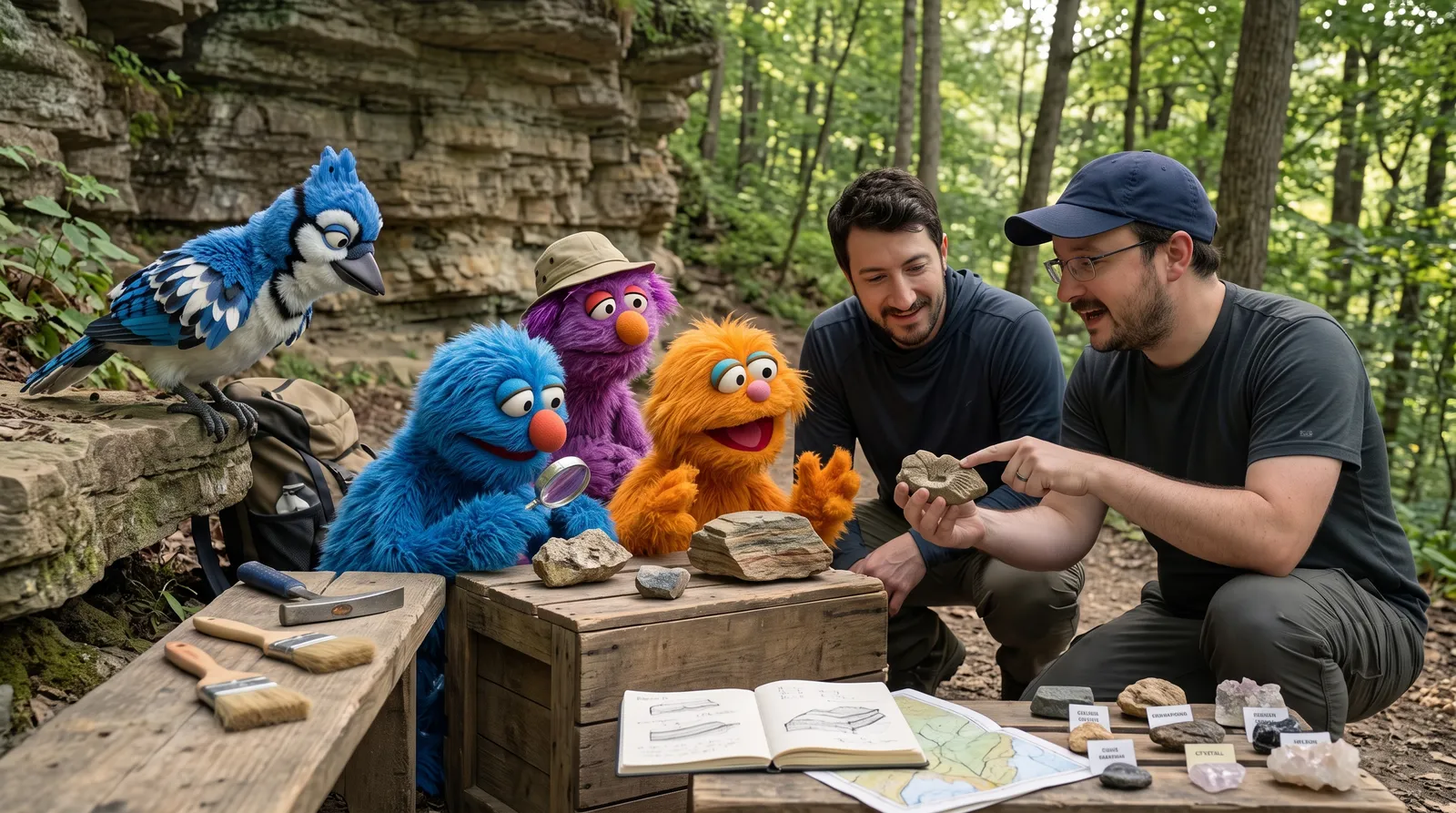
A short drive north of Juniper Falls, the Lehigh River has carved a deep, winding gorge through the mountains, with waterfalls tumbling down the side streams and rock walls rising up on both sides. That’s the Lehigh Gorge, one of my favorite places on Earth, and for Episode 5, “Rocks Remember,” we took the whole neighborhood there.
Why the Lehigh Gorge?
Because the rock there tells a story you can actually see.
The walls of the gorge are made of layers of sandstone, shale and pebbly rock. More than 300 million years ago, long before the dinosaurs, rivers flowed down from a range of mountains that has long since worn away, spreading sand, mud and pebbles across this part of Pennsylvania. Layer after layer piled up, got buried, got squeezed, and slowly turned to stone. Then, over a very long time, the Lehigh River sliced back down through all those layers, carving the gorge people hike and bike through today.
So when you stand at the bottom of one of those cliffs, you’re standing in front of a stack of pages, and each layer is a chapter.
What we packed
A geologist’s kit is simpler than you’d think. Here’s what came along:
- A field notebook for sketches and notes (Pumpkin’s Big Orange Notebook was very proud to be involved)
- A magnifying glass, which Jean-Baptiste refused to put down
- Soft brushes for sweeping dust off a find
- A trail map, folded the wrong way by Peanut
- Little labels for every rock we looked at
- Snacks. Mostly chocolate raisins.
One important rule: in parks, we look, we learn, and we leave rocks where we find them. We photographed and sketched our finds instead of taking them home. (Antoine, J.B.’s famous ripple-mark rock, came from a construction site back in town, with permission.)
Reading the rocks
The best moment of the day belonged to Jean-Baptiste. Peering through his magnifying glass at a slab near the trail, he spotted a pattern of tiny wavy lines: ripple marks. They’re the same ripples you see in the sand at the bottom of a creek today, except these were made by moving water hundreds of millions of years ago and then turned to stone.
“The rock remembers the water,” J.B. whispered. And that’s how the episode got its name.
Other things we learned that day:
- Layers on the bottom are usually older than layers on top, like a stack of laundry where the bottom shirt has been there longest.
- Different colors in the rock can mean different minerals. The rusty red layers in the gorge get their color from iron.
- Water is the world’s slowest sculptor. The gorge we hiked through took far longer to carve than people have existed.
Flufflepuff’s hat
You might notice Flufflepuff wearing a bucket hat in the photo. She insisted that “real geologists wear hats,” and, honestly, she’s not wrong. Sun protection matters on a long day outside. She also asked 37 questions on the trail. Pumpkin counted. Our favorite: “If rocks remember, do they remember us?”
We’re still thinking about that one.
Try it yourself
You don’t need cliffs to be a geologist. Next time you’re outside, pick up three rocks (with permission!) and look at them up close. Are they smooth or rough? Speckled or plain? Do they have layers? Sketch them, give them names, and then put them back where you found them. Congratulations, you’re doing science.
Ty