
Can a blue jay learn calculus?
On Poppy Seed Street we think no idea is too big for a curious mind. Here’s how we’re teaching the heart of calculus with blocks, a hill and a skateboard.
 Todd
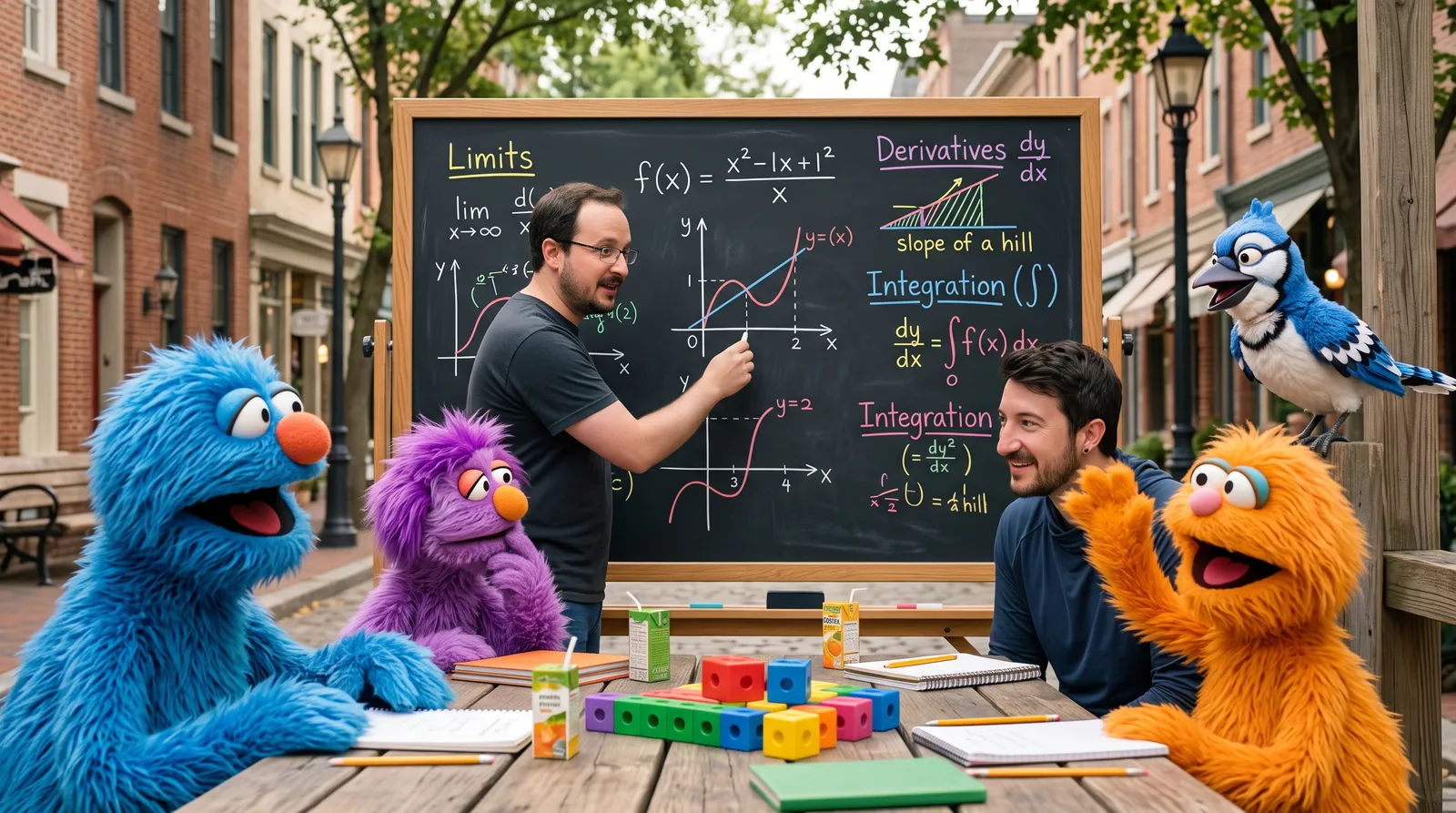
When we told people Episode 6 was about calculus, we got a lot of raised eyebrows. Calculus? On a show for kids? Isn’t that, like, college?
Here’s the thing. The ideas at the heart of calculus are not complicated. The notation can be intimidating. The homework can be long. But the core idea is something every kid who has ever ridden a bike up a hill already understands in their legs.
The big idea: how fast is something changing?
That’s it. That’s calculus, at its heart.
Imagine you’re walking up a hill. At the bottom it’s flat, and walking is easy. Halfway up it gets steep, and your legs start to burn. Near the top it levels out again. The steepness is changing as you go, and calculus is just a careful way of asking how steep is it, right here, right now?
On the chalkboard in the photo, you can see we wrote “slope of a hill” right next to the fancy symbols. That’s on purpose. We always start with the hill and only add the symbols at the very end, and only for the grown-ups who want them.
How we teach it on the street
Step 1: Blocks. We build staircases out of counting blocks. A staircase that goes up one block for every one step forward is gentle. One that goes up three blocks for every step forward is steep. Pumpkin counts, and suddenly “rise over run” is just counting.
Step 2: The hill. We go outside and find a real hill (Juniper Falls has plenty), and everybody walks up it and points out where it feels steepest. Jean-Baptiste, who is big and blue and not built for hills, is an excellent steepness detector.
Step 3: The skateboard. Ty rolls a skateboard down hills of different steepness and we watch what happens. Steeper hill, faster board. The change in the hill changes everything else.
Step 4: The question. Then Flufflepuff asks the question that makes it calculus: “But what about when the hill is curvy? How steep is it at just one spot?” And we zoom in. If you zoom in close enough on any smooth curve, it starts to look like a straight line, and a straight line has a slope you can count with blocks.
That’s the derivative. A five-year-old puppet figured it out with blocks.
So… can a blue jay learn calculus?
Peanut would like the record to show that he understood it “immediately and completely.” (He fell asleep during Step 2.)
But yes. We think almost anybody can grasp almost any big idea if you start where they are and use words and things they already know. That’s the promise of the whole show: nothing is off-limits just because it sounds hard. We’d rather a kid hear the word “calculus” for the first time from a fuzzy friend and a hill than from a scary textbook ten years later.
And if you’re a grown-up who never quite got calculus in school? Watch with your kids. It’s never too late to meet the hill.
Todd