A show about learning, for everyone, at every age. Poppy Seed Street is a digital learning show for every age, filmed on one very friendly street in Juniper Falls, Pennsylvania. Meet Todd, Ty, Flufflepuff, Jean-Baptiste, Peanut and Pumpkin.
Our street’s favorite flower
What Is a Poppy?
Our street is named for them, our bakery is famous for them, and Pumpkin counts them every June. Here’s everything we know about poppies, from petal to pod to bagel.
Meet the poppy
A poppy is a flowering plant. There are dozens of different kinds, and the best-known ones belong to a group scientists call Papaver, which is Latin for poppy. Most grow from seed to flower in a single season, and they love sunny spots and soil that’s been freshly dug.
Poppies are famous for their big, papery petals in bold colors: fire-engine red, sunset orange, lemon yellow, soft pink, even sky blue. In the middle is a fuzzy ring of stamens dusted with pollen, and in the very center sits the part that will become the seed pod.
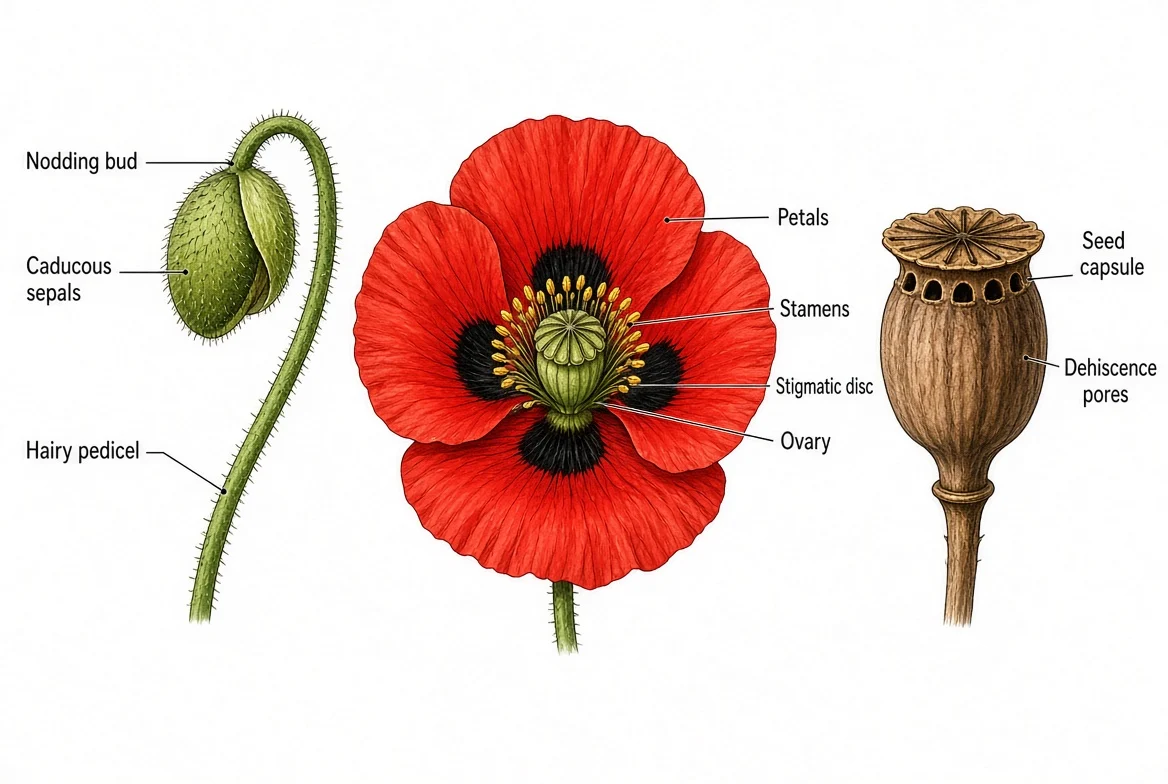
A poppy, part by part
From a nodding bud, to a flower, to a seed capsule ready to sprinkle.
Nodding bud
Before it opens, the bud hangs its head on a curved stalk. Just before blooming, the stalk straightens and the bud looks up.
Caducous sepals
The two fuzzy green covers that protect the bud. “Caducous” means “falls off early”: they drop away the moment the flower opens.
Hairy pedicel
The pedicel is the little stalk that holds up a single flower. A poppy’s is covered in tiny bristly hairs.
Petals
Four silky petals, crumpled in the bud like tissue paper. Field poppies often have a dark blotch at the base of each one.
Stamens
The ring of thin stalks around the middle, each tipped with pollen. Bees love it.
Ovary
The round green center, where the seeds grow. After the petals fall, it swells into the seed capsule.
Stigmatic disc
The flat, ridged “lid” on top of the ovary. Pollen lands on its rays, like spokes on a wheel.
Seed capsule
The ovary, all grown up and dried out. One capsule can hold more than a thousand tiny seeds.
Dehiscence pores
The ring of little windows under the lid. “Dehiscence” is a scientist’s word for opening up to let seeds out. When the wind shakes the stalk, out they sprinkle.
Poppy facts that make us say “whoa”
Crumpled like tissue paper
A poppy’s petals are squashed inside the bud, so when the flower opens they’re all crinkly, like tissue paper pulled out of a gift bag. They smooth out a little in the sun.
Buds that bow
Poppy buds droop on curved stems, as if they’re bowing. Just before blooming, the stem straightens up and the bud lifts its head to the sky.
Nature’s salt shaker
After the petals fall, the seed pod dries into a little capsule with a lid and a ring of tiny windows under it. When the wind shakes the stem, seeds sprinkle out like salt from a shaker.
Bees see something we can’t
Poppies make no nectar, but bees love their pollen. Bees can’t see red the way we do, but red poppy petals reflect ultraviolet light, which bees can see. To a bee, a poppy glows.
Seeds that wait
Field poppy seeds can rest underground for many years, even decades, until the soil gets turned over and sunlight reaches them. Then up they come!
Here today…
A single poppy flower often lasts only a day or two. But each plant makes bud after bud, so a patch can bloom for weeks.
The poppy family
A few of our favorite cousins, in every color of the sunset (and one of the sky).
Field poppy
Corn poppy · Papaver rhoeas
The classic: four silky scarlet petals, often with a black spot at the base. It pops up in fields and roadsides across Europe, and it’s the red poppy that blooms on our street every June.
California poppy
Eschscholzia californica
Bright orange and the official state flower of California. It folds its petals shut at night and on cloudy days, like it’s tucking itself in.
Iceland poppy
Papaver nudicaule
Comes in sherbet colors: peach, pink, lemon and cream. Its wild relatives grow in chilly places near the Arctic, where summers are short and bright.
Oriental poppy
Papaver orientale
The giant of the family. Its flowers can be as big as a dinner plate, with dramatic dark blotches. It comes back in the garden year after year.
Himalayan blue poppy
Meconopsis
A rare, true sky-blue poppy from the high, misty mountains of the Himalayas. Notoriously fussy to grow, which makes gardeners love it even more.
Welsh poppy
Papaver cambricum
A cheerful lemon-yellow poppy that’s happy in shady, damp corners where most poppies would sulk.
Poppies in the kitchen
The poppy seeds you sprinkle on food come from a special kind of poppy grown just for its seeds, sometimes called the breadseed poppy. Each seed is tiny, about a millimeter across and shaped like a little kidney bean. One seed pod can hold more than a thousand of them, and it takes a couple of thousand to weigh just one gram!
Poppy seeds taste nutty, a little sweet, and toasty, and they add a happy little crunch. They come in a few colors:
Blue-gray, the most common kind in Europe and North America, and the ones on your bagel.
White or cream, popular in Indian cooking, often ground into creamy sauces.
Brown, used in parts of the Middle East and Turkey, sometimes ground into a sweet paste.
Chef’s tip from the Seed & Crumb: warm poppy seeds in a dry pan for a minute or two, shaking the pan, until they smell toasty. It wakes up their flavor. (Grown-ups handle the stove!)
Poppy seeds around the world
USA & CanadaPoppy seed bagels
Montréal-style or New York-style, depending on who you ask. (Ask Jean-Baptiste. Actually, maybe don’t.)
UkraineMakivnyk
A rolled sweet bread with a dark swirl of poppy seed filling, made for holidays. The bakery on our street started with this one.
PolandMakowiec
A close cousin of makivnyk: a poppy seed roll that’s a must at Christmas and Easter.
CzechiaKoláče
Round pastries with a dimple in the middle filled with sweet poppy seed, fruit, or farmer’s cheese.
HungaryMákos tészta
Noodles tossed with ground poppy seeds and sugar. Yes, sweet noodles. Yes, they’re wonderful.
Jewish bakingHamantaschen
Three-cornered cookies, and one of the classic fillings is “mohn,” a sweet poppy seed paste.
IndiaKhus khus & posto
Creamy white poppy seeds are ground into rich, nutty pastes for curries; in Bengal, posto dishes are a favorite.
EverywhereLemon poppy seed muffins
Flufflepuff’s favorite. The crunchy tops are the best part.
Jean-Baptiste’s corner
Why poppy seeds hit different on a bagel
“Okay. Okay. Listen.” (This is how Jean-Baptiste starts every conversation about bagels.)
A bagel is boiled before it’s baked. That bath gives it a shiny, chewy crust, and it makes the outside just tacky enough for seeds to stick. Then the oven toasts the poppy seeds right on the crust, so every bite gets a little crackle and that warm, nutty flavor. Soft and chewy inside, crunchy and toasty outside. “That,” says J.B., “is perfection.”
The poppy seed bagel is the classic. But the everything bagel is the party: poppy seeds, sesame seeds, dried garlic, dried onion and flaky salt, all at once. Here’s J.B.’s recipe for the topping, to shake on bagels, eggs, avocado toast, or popcorn.
J.B.’s Everything Seasoning
Makes about ½ cup · No cooking
2 tbsp poppy seeds
1 tbsp white sesame seeds
1 tbsp black sesame seeds
1 tbsp dried minced garlic
1 tbsp dried minced onion
2 tsp flaky sea salt
Measure everything into a jar. (Count the spoonfuls out loud. Pumpkin insists.)
Put the lid on tight and shake, shake, shake.
Sprinkle generously. Store in the cupboard for up to a few months.
“Un, deux, trois… on mange!” (“One, two, three… let’s eat!”)
Pumpkin’s planting guide
Grow your own poppies
Pumpkin has planted the Poppy Seed Street beds for three springs now. Here’s her method.
Pick a sunny spot
Poppies love sunshine. Find a place that gets at least six hours of it a day.
Sow in fall or early spring
Poppies like to start out in cool weather, so plant them when it’s chilly but the ground isn’t frozen.
Mix the seeds with sand
The seeds are so tiny they all fall in one clump! Stir a pinch of seeds into a cup of sand, then sprinkle the mix so they spread out evenly.
Don’t bury them
Just press the seeds gently onto the soil. They need a little light to wake up.
Water gently, then wait
Use a fine sprinkle so the seeds don’t wash away. Sprouts appear in two to four weeks. Count them!
Leave them where they grow
Poppies have long, delicate roots and don’t like to be moved. Plant them right where you want them to bloom.
Pumpkin’s safety tip: garden flowers are for looking at, not for eating, and that goes for pets too. Always garden with a grown-up, and wash your hands when you’re done.
The poppy of remembrance
After the First World War, red field poppies bloomed across the battlefields of Belgium and France, and they became a symbol of remembrance. Today, in many countries, people wear a small red poppy in November to remember those who served. It’s one more reason this little flower means so much to so many people.