


Sparks will fly (safely!)
How we teach electricity on a show for little ones, plus a simple battery-and-bulb circuit you can build at home with a grown-up.
 Todd
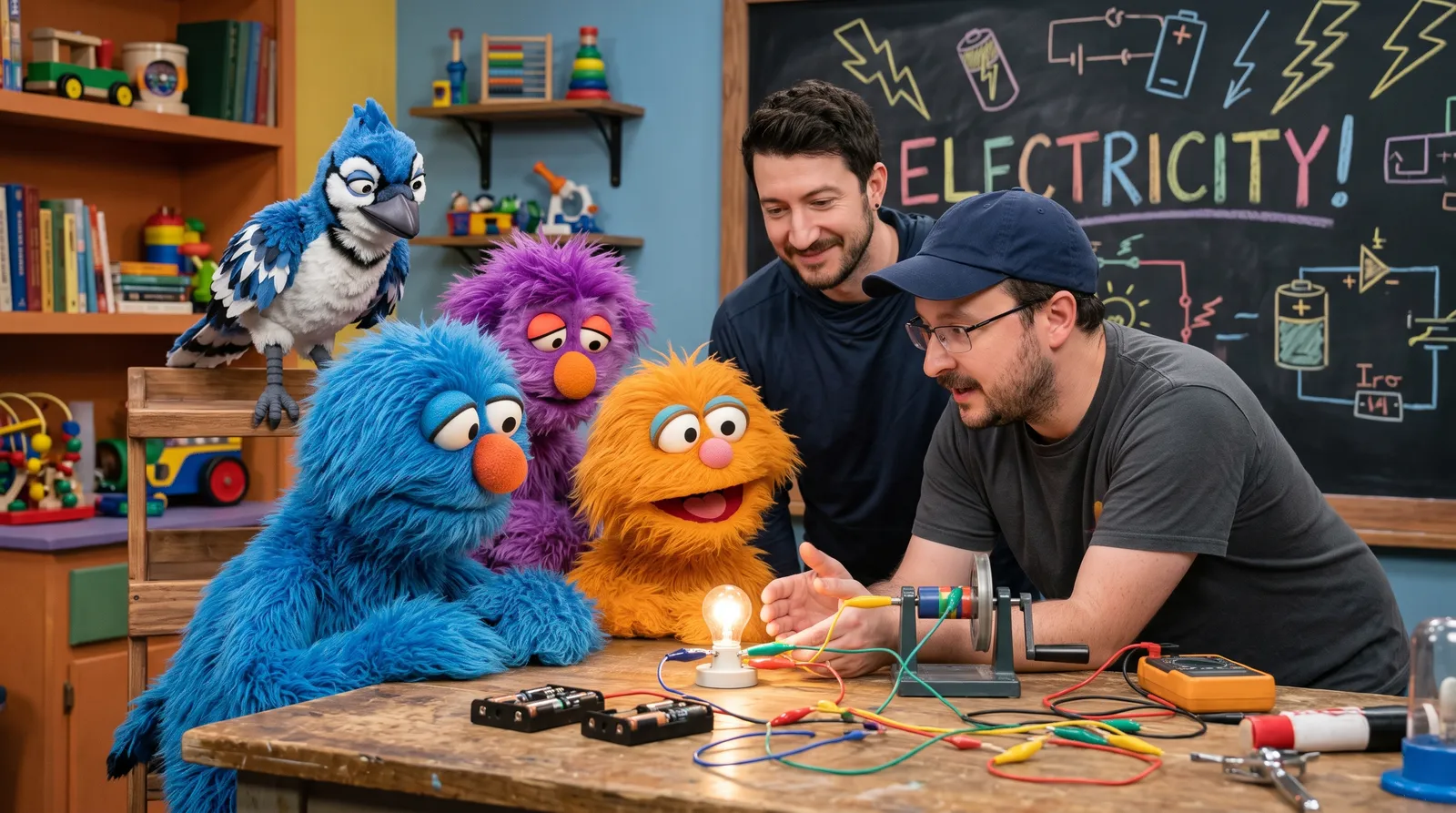
In Episode 3, “Sparks & Circuits,” the neon sign at the Seed & Crumb bakery goes dark, and the neighbors set out to find out why. Electricity is one of my favorite topics to teach, because it’s everywhere, it’s invisible, and it does something that feels like magic every time: you close a loop, and a light turns on.
It’s also a topic where safety comes first, and we take that very seriously.
The number one rule
Before any wires came out, everyone on the street learned the rule:
We only experiment with small batteries. We never, ever play with wall outlets, plugs or power cords.
The electricity that comes out of the wall is much stronger than a battery and can badly hurt you. A couple of AA batteries, on the other hand, are gentle enough for us to explore with. In the episode, Jean-Baptiste asks if he can “just try it with the toaster,” and the answer from every single neighbor is a very loud no.
What a circuit is
Electricity needs a complete path, a circuit, to flow. Think of it like a race track. If the track makes a full loop, the race cars (the electricity) can zoom around and around. If there’s a gap in the track, everything stops.
A light switch is just a tiny gap you can open and close. Flip it on, the loop is complete, and the light glows. Flip it off, there’s a gap, and the light goes dark.
That’s what happened to the bakery sign: a wire had wiggled loose and left a gap. (Mrs. Marchenko called a licensed electrician to fix the real sign, which is exactly the right thing to do.)
Try it at home: battery + bulb
With a grown-up, you can build the same circuit we built on the show.
You’ll need:
- 2 AA batteries in a battery holder (with wires attached)
- A small flashlight bulb in a bulb holder, or a single LED
- 2 or 3 short wires with alligator clips
- Some test objects: a spoon, a coin, a pencil, an eraser, a paper clip, a dry leaf
What to do:
- Clip one wire from the battery holder to one side of the bulb holder.
- Clip another wire from the other side of the bulb holder and leave its end free.
- Touch the free end to the battery holder’s other wire. Light! You’ve made a circuit.
- Now leave a gap between those two ends and bridge it with your test objects, one at a time. Which ones make the bulb light up?
Things that let electricity through are called conductors. Things that don’t are called insulators. On the show, Pumpkin made a chart, and Peanut was devastated to learn that a dry leaf is an insulator. (“But it’s so crunchy.”)
If you use an LED and it doesn’t light, flip it around. LEDs only let electricity flow one way!
Why we love teaching this
The look on someone’s face when a little bulb glows for the first time, because of a loop they built, never gets old. In the photo you can see all four puppets leaning in, and I promise you those are real “ooooh”s.
That’s what we’re after on Poppy Seed Street: not just knowing how something works, but feeling the thrill of figuring it out yourself.
Todd