
Helmets, knee pads and Newton
Flufflepuff learns to skateboard in “Wheels, Wobbles & Balance.” What Ty’s skate school teaches about gear, gravity, and getting back up.
 Ty
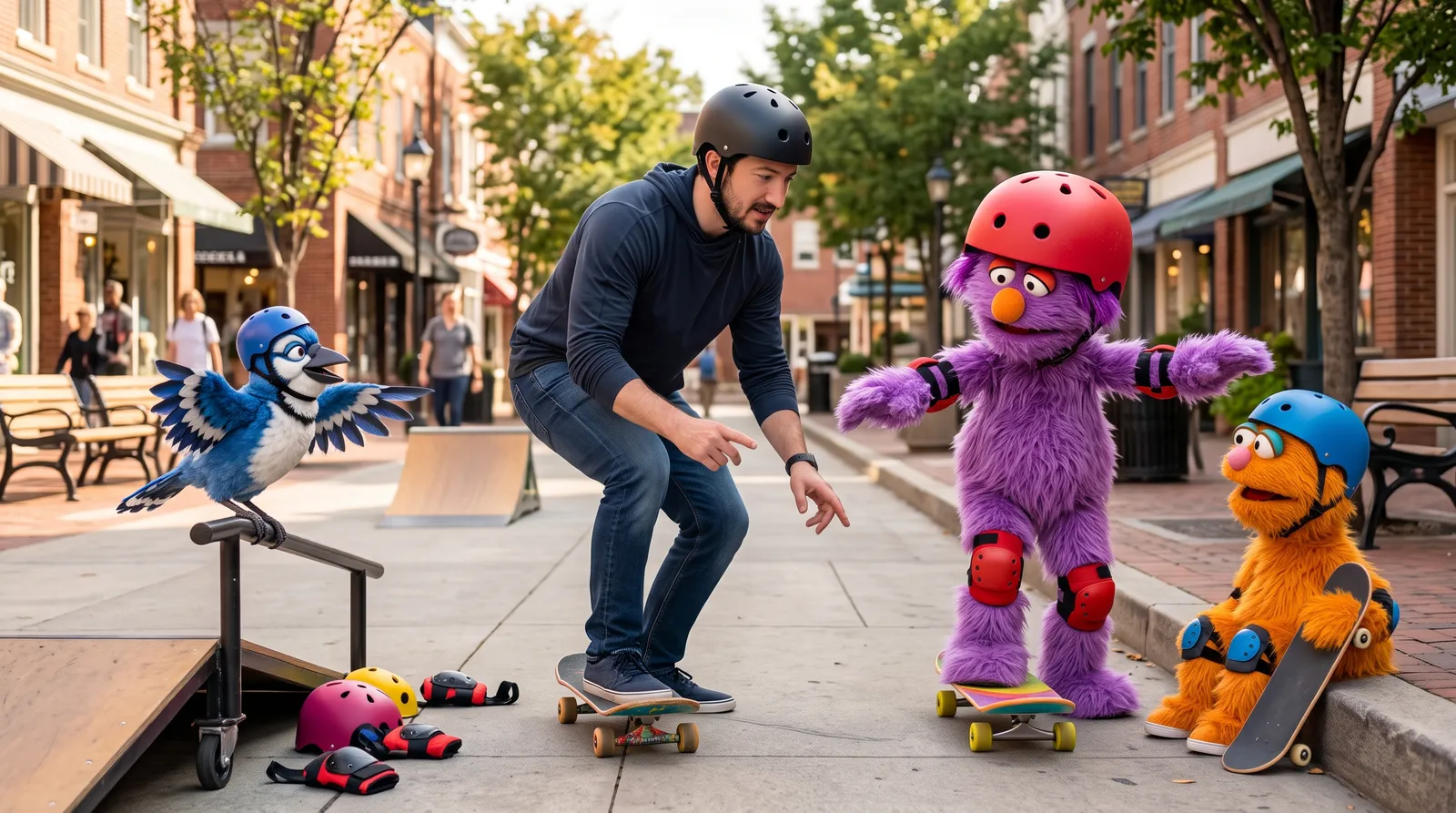
I’ve been skateboarding on Poppy Seed Street for years. The neighbors even named a curb after me (Ty’s Ledge, right in front of my house, if you’re ever in town). So when Flufflepuff came to me this spring and said, “Teach me,” I was thrilled. Then she asked why a skateboard doesn’t fall over, and we had an episode.
Lesson one: gear before anything
Before Flufflepuff touched a board, we did the most important part:
- Helmet: snug, level on your head, strap buckled. (Hers is bright red. She picked it.)
- Knee pads and elbow pads, because you will fall, and that’s okay.
- Wrist guards, which most people forget. Wrists take a lot of falls.
- Closed-toe shoes with flat soles.
Pumpkin wore all of the above plus a blue helmet, and she didn’t even want to skate. She said she was “skating-adjacent” and wanted to be prepared. Respect.
Lesson two: your center of gravity
Here’s the physics. Everything has a center of gravity, a balance point where its weight is centered. For you standing up, it’s around your belly button. As long as your center of gravity stays over your base, the area between your feet, you stay up. Lean too far past your base, and gravity wins.
That’s why on a skateboard you:
- Bend your knees. This lowers your center of gravity and makes you steadier. (Try standing on a moving bus with straight legs vs. bent knees. Bent knees win every time.)
- Keep your feet wide, over the bolts. A wider base is harder to tip.
- Look where you want to go, not at your feet. Your body follows your eyes.
Jean-Baptiste, who is very tall and very blue, discovered that his center of gravity is “extremely up.” He did not skate. He did build an excellent ramp.
Lesson three: Newton was right
Isaac Newton figured out a long time ago that things in motion want to stay in motion. Physicists call that inertia. You can feel it on a skateboard: when the board stops suddenly (say, by hitting a pebble), you keep going forward. That’s why we practice on smooth ground, go slow, and always watch for pebbles.
Newton also figured out that every push has an equal push back. When you push off the ground with your foot, the ground pushes you forward. Peanut called this “the most polite law in science.”
Lesson four: falling is part of it
Flufflepuff fell off eleven times that first afternoon. She got back on twelve.
We made a big deal about how to fall, too: if you’re going down, crouch low, try to roll, and let your pads do their job. But mostly we talked about the getting-back-on part. Learning anything new (skateboarding, reading, fractions, a new language) means being bad at it for a while first. Everybody you’ve ever seen do something well fell off a bunch of times first.
By the end of the day, Flufflepuff rolled the whole length of the block without stopping, with Pumpkin jogging next to her counting out loud, and Peanut supervising from the handrail. I’ve landed a lot of tricks in my life. That ride was better than all of them.
Ty
Skating safely: always wear a helmet, ride with a grown-up, stay off busy streets, and start on smooth, flat ground.